© Rossiya Segodnya · RIA Novosti · English translation
‘Made in Russia’ Forum Discusses Doing Business in the Middle East and Africa
The forum discussed doing business in the Middle East and North Africa
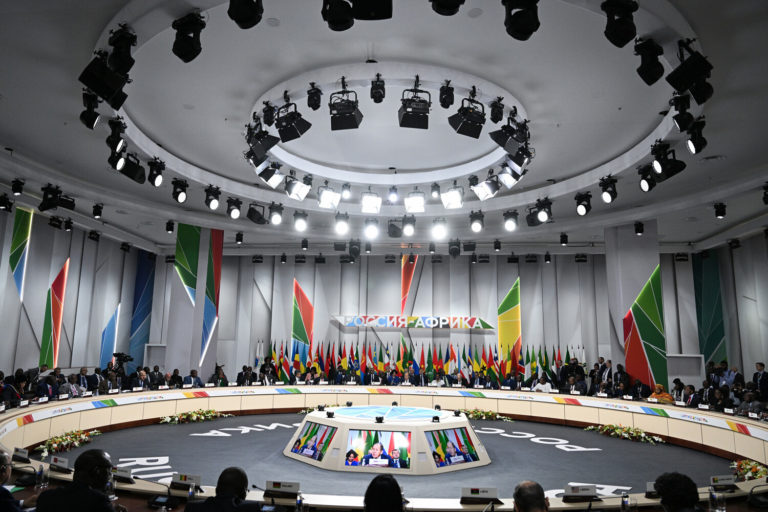
MOSCOW, November 16 — RIA Novosti. The Made in Russia forum discussed how to establish a lasting foothold in Middle Eastern and North African markets, the Russian Export Center (REC, part of VEB.RF) reported.
“Russian companies seeking to operate in Middle Eastern and North African markets over the long term need to adapt their products to local demand, build partnerships with regional businesses and use existing sales channels. Participants in the Made in Russia International Export Forum at the National Centre RUSSIA discussed practical ways to address these challenges. The event is organized by the Russian Export Center,” the press release said.
At the session “Entering MENA Markets: From Assumptions to Action,” representatives of Russian and foreign companies, government authorities and development institutions discussed how to turn export potential into concrete projects and establish a lasting presence for Russian businesses in the Middle East and North Africa. The discussion was moderated by Olga Gerasimova, the REC representative in Saudi Arabia, and Marat Zembatov, Director of the Center of Interdisciplinary Research at HSE University’s Institute for Public Administration and Governance.
One of the main topics was whether Russian exporters are ready to adapt to the specific needs of regional markets. Participants focused on localizing products, design, communications and customer service, as well as expanding cooperation with local partners. They saw this approach as a basis for moving from individual export shipments to long-term operations in the Middle East and North Africa.
Participants considered the opportunities available to Russian suppliers in light of the needs of individual industries. Margarita Bolycheva, Bashkortostan’s Minister of Foreign Economic Relations and Congress Activities, presented the region’s export potential. Denis Vodnev, Marketing Director at Natsproektstroy Group, discussed opportunities for Russian companies to take part in infrastructure projects. Natalia Babina, Managing Director of the International Development Division at Sistema, discussed the development of technology exports and international partnerships.
Cooperation with Saudi businesses provided a practical example of how to promote Russian products.
The discussion also addressed the importance of taking foreign partners’ interests into account. Apozon Group CEO Bayar Omar shared how Middle Eastern businesses view Russian suppliers. Ahmed Azimov, Chairman of the Russian-Algerian Business Council at the Chamber of Commerce and Industry of the Russian Federation and Chairman of the Board of the Center for International Strategic Initiatives, discussed opportunities to expand cooperation with North African countries.
Companies already operating in the Middle East and North Africa shared case studies on doing business in the region. Speakers included Anastasia Rusakova, Head of Middle East Sales at POLATI, Alexander Petrov, CEO of the Saudi Arabian branch of PO Vozrozhdenie, and Elena Egorova, project manager for 2GULF Express. Mohamed Rashwan, head of the Moscow office of UAE-based TRENDS Group, presented an analysis of business development in the region. Public figure and philanthropist Ivan Molchanov also spoke at the session.
As part of a discussion on ways to enter foreign markets, Olga Gerasimova, the REC representative in Saudi Arabia, described the support available to companies as they adapt their products and look for business partners. The discussion also gave particular attention to opportunities to build business ties through joint projects, including beyond traditional trade in goods. The discussion also gave particular attention to opportunities to build business ties through joint projects. “Every country today is moving toward digitalization and technological sovereignty, and neither that transition nor the adoption of artificial intelligence is possible without reliable cybersecurity. True sovereignty means that a country can rely on its own technologies, specialists and experts without being critically dependent on external factors. That is why our approach does not consist in selling individual solutions and services directly. Cyberdom’s task is to help the partner country build its own ecosystem by developing a local community of specialists, launching its own startups and creating domestic information security products that can later be scaled for use abroad as well. Russia has unique practical experience in cybersecurity, and we are open to working together to establish similar centers of expertise abroad,” said Aleksandra Shadyuk, Deputy CEO of Cyberdom.
The session participants considered joint cyber games, cybersecurity exercises and cybersecurity training as possible forms of cooperation between Russian IT teams and their Saudi partners. The initiative is still under consideration.
The Made in Russia International Export Forum takes place on November 16. This year’s main theme is high-tech exports. More than 5,000 people from 89 countries are taking part.
The Russian Export Center (REC, part of VEB.RF) is a state institution that supports non-commodity, non-energy exports. It provides financial and non-financial assistance to companies across industries at every stage of entering international markets, including through the International Cooperation and Export national project. Most services offered by the REC Group are available on the Gosuslugi VED digital platform for foreign trade. The REC is primarily responsible for administering and implementing the Made in Russia program. The REC Group includes EXIAR, Roseximbank and the REC Export School.
Source: RIA Novosti (in Russian). Photo: Pelageya Tikhonova / RIA Novosti.