Algeria is strengthening its position in the steel industry by attracting a major Chinese investor. Jingdong Steel is implementing a project to build a modern steel production complex worth USD 500 million in the Draa El Hadja industrial zone (M’sila Province). The project is considered one of the key industrial initiatives of recent years and is aligned with Algeria’s strategy to diversify its economy and reduce dependence on imports of steel products.
Project parameters and configuration
The new complex will be located on a site of approximately 36 hectares in the Draa El Hadja industrial zone, allocated under a concession agreement with the Algerian Investment Promotion Agency (AAPI). The total investment volume is estimated at around USD 500 million, placing the project among the major “structuring” initiatives for the region’s industrial development.
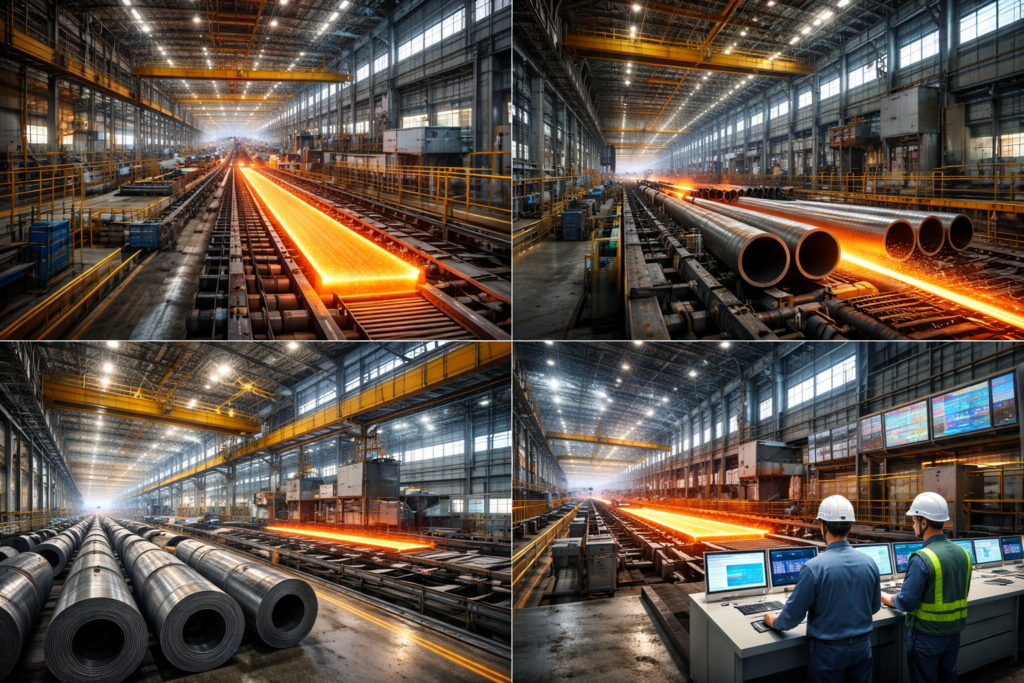
The planned production capacity of the complex will reach up to 500,000 tons of steel products per year. The project will be implemented in two phases: the first phase предусматривает the launch of a steel sheet production line with a capacity of about 200,000 tons per year, while the second phase involves the establishment of a steel pipe production facility with an annual capacity of approximately 300,000 tons. This configuration will allow the project to meet the needs of several sectors simultaneously, including construction, infrastructure, oil and gas, and municipal utilities.
Focus on the domestic market and exports
According to the project parameters, about half of the output will be supplied to the Algerian domestic market, while the remaining 50% is planned for export. The primary external markets include North African countries and potentially the Middle East, where demand for flat steel products and steel pipes for construction and infrastructure projects remains strong.
Special attention is being given to the localization of raw material supply. Up to 80% of raw materials are expected to be sourced locally, including integration with major iron ore projects such as the Gara Djebilet deposit. This approach is intended to reduce import dependence and enhance the resilience of supply chains for Algeria’s steel industry.
Employment and human capital development
The project also has a strong socio-economic dimension. Official estimates indicate the creation of approximately 1,100 direct jobs at the facility and up to 2,000 indirect jobs in logistics, services, construction, and related sectors. For the M’sila region, which is being positioned as an emerging industrial hub, this represents a significant contribution to employment and local development.
A separate component of the project предусматривает the establishment of a training and retraining center aimed at preparing local specialists in modern steelmaking, rolling, and pipe production technologies. This aligns with the objective not only to attract investment but also to ensure technology transfer and strengthen the competencies of Algerian personnel in the steel sector.
Current implementation status
The concession agreement and project implementation permit were officially issued in June 2025. As of February 2026, Algerian official and industry sources report that the project has reached approximately 60% completion: the main industrial infrastructure has been established, key buildings have been constructed, and installation and preparation for technological equipment for sheet and pipe production lines are underway.
At present, the complex has not yet been commissioned. The launch of production lines is expected to take place in stages, with sheet production starting first, followed by pipe manufacturing. Based on the current pace of construction, commissioning may occur during the period 2026–2027, although exact timelines remain within the competence of the investor and Algerian authorities and may be adjusted during the commissioning process.
Significance for Algeria’s industrial strategy
The Jingdong Steel project fits well within Algeria’s industrial strategy aimed at economic diversification, the development of downstream processing industries, and reducing imports of higher value-added products. The new complex will complement existing steel production capacities and strengthen Algeria’s potential as a future export hub for steel and pipes in the North African region.
The launch of the plant is expected to reduce imports of steel sheets and pipes, support the creation of a local value chain based on the national raw material base, increase export potential for steel products, and accelerate industrial development in the M’sila region.
For foreign investors, the project serves as an important signal that Algeria is ready to provide favorable conditions for large industrial companies, including access to land, raw materials, and a growing domestic market. It also demonstrates the effectiveness of the updated investment framework and the role of AAPI as a key partner for strategic projects.
Source: RABC Media